Unicode is a numbering system that encodes characters, symbols, and emoji so that they can be processed, shared, and displayed. At the core of Unicode are code points — Unicode’s numbered meanings. Unicode has its own encoding schemes, primarily UTF-8 and UTF-16.
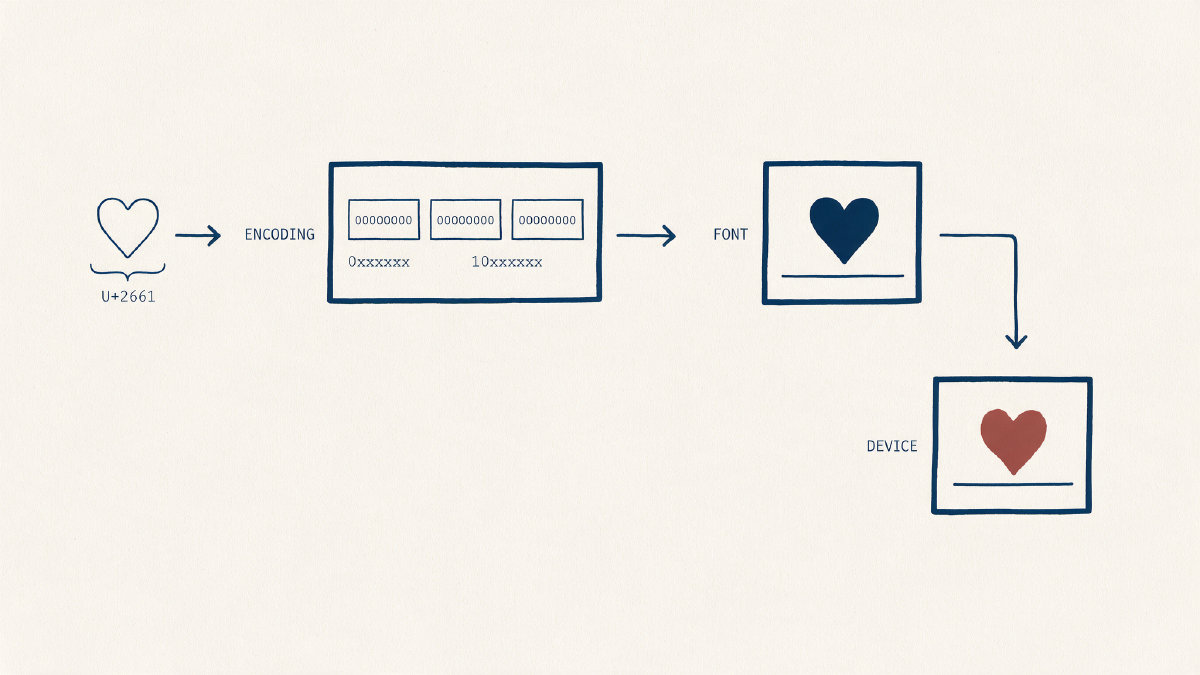
When you paste an aesthetic symbol (like those from 840 production) into another app or device, it travels as text rather than as an image. It may not look the same on another platform because of how fonts work: one font will draw one glyph (visual character), another will draw another. The underlying text values remain consistent across platforms.
Some symbols require multiple code points in sequence to produce their full design. This isn’t necessarily a problem. In some cases, though, it might matter whether you have all the pieces of a given aesthetic sequence. If you don’t, you’ll end up with something that’s missing parts or just plain broken.
In short, there are no warnings about problems; there are only observations. You’ll see what works and what doesn’t. But when we talk about successful encoding, it should be contrasted with successful display, which means the operating system, apps, fonts, etc., are displaying the correct glyph, or at least substituting another glyph style that conveys the same meaning.
Unicode’s encoding system, called UTF, includes schemes such as UTF-8, UTF-16, and UTF-32. Both UTF-8 and UTF-16 convert a sequence of Unicode code points into bytes using variable-length encoding; UTF-8 uses one to four bytes per code point, while UTF-16 uses two or four bytes. UTF-8 is common online.
Unicode
You may have heard of Unicode as if it were one thing, but the Unicode Standard is a universal character encoding designed to support the worldwide interchange, processing, and display of written text. It defines the world of written texts using letters, marks, symbols, and emoji.
UTF, then, describes encoding schemes for transferring these bits around the web and into software. There are different encodings, like UTF-8 and UTF-16. While each encoding turns a sequence of Unicode code points into bytes, UTF-8 is the more commonly used scheme.
A code point is a unique number that represents a specific character, symbol, or emoji. Each code point is represented by a hexadecimal number, which begins with “U+”. For example, the letter “a” is encoded as U+0061 and the letter “Z” as U+005A. In total, there are over 143,000 code points defined by Unicode, including symbols such as emojis, accented characters, and special characters from various languages and writing systems.
Text is a sequence of code points. When you copy-paste an aesthetic symbol from 840 production, it travels as text. This also applies to your typical copy-pasting of text between apps on a phone or computer. In fact, this process usually works very well. Your aesthetic symbols will appear almost identically where they’re pasted. What could go wrong?
Well, the way a symbol looks is controlled by the font and rendering system. For instance, if you open Microsoft Word and click Insert > Symbols > More Symbols, you can insert the symbol ♡. That may render similarly to copying-and-pasting the symbol from the Web or inserting it from Word itself, though the exact look still depends on the font and rendering system.
But the underlying text value remains consistent. To prove this, I created a catalog of aesthetic symbol sequences from the 840 production catalog and ran a sequence audit against them, revealing the exact underlying values being copied.
Copy and Paste
There are many aesthetic symbols, however, that are multi-code-point designs. These are ordered text constructions that may contain base symbols, spaces, combining marks, or variation selectors. These aren’t really separate entities. They’re simply combinations of different Unicode code points arranged to create a visual design.
This is why it helps to preview your symbols before sharing them elsewhere. Not every app, social media platform, username field, or device supports all the Unicode characters and aesthetics we love. Some apps will substitute one aesthetic for another — perhaps adding extra spacing, changing the color, or replacing one emoji with another. Other apps may show a box or question mark. Still others will outright fail to support a particular character.
I’ve seen both successes and failures in the testing of aesthetic symbols, and they haven’t always been consistent across platforms. As someone who lives and breathes symbols, I’ve seen a few examples of this.
In short, there are no warnings about problems; there are only observations. You’ll see what works and what doesn’t. However, it’s worth noting that the majority of these tests have succeeded, either through substitution or direct use of the symbol.
Encoding is not rendering. Just because the operating system recognizes the symbol does not mean that the app knows how to display it. The same goes for devices. Some apps may fail to recognize or display certain characters, resulting in the infamous “missing font” error or a “unsupported character” error.
The key takeaway is that your symbol can be successfully encoded and often rendered on modern devices, but support still varies. And if a symbol is unsupported, it may be substituted, but it could also appear as a box, question mark, or something else entirely. On iOS, for instance, you can expect that an aesthetic symbol that isn’t supported will either render in a slightly different style, or else show a box.
Emoji Are Characters Too
So what do emoji have to do with any of this? Emoji are characters too, like the letter ‘a’ or the letter ‘Z’. So you can treat them just like any other characters within text.
But some apps, such as social media platforms, usernames, and profiles, may add their own rules. That said, emoji are part of Unicode, so your device needs support for the specific emoji character or sequence, along with an appropriate font and rendering implementation, for it to be displayed properly.
It’s always good to preview your symbol in the destination beforehand. After all, nothing beats seeing what it looks like once it gets there.